

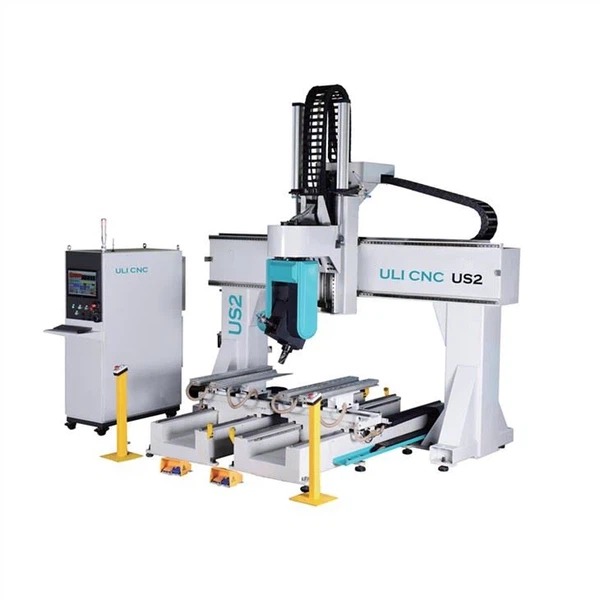
What is a five-axis CNC machine?
5-axis machining provides infinite possibilities as to the part sizes and shapes you can effectively process. The term “5-axis” refers to the number of directions in which the cutting tool can move. On a 5-axis machining center, the cutting tool moves across the X, Y, and Z linear axes as well as rotates on the A and B axes to approach the workpiece from any direction. In other words, you can process five sides of a part in a single setup.
5 axis CNC machine tools are a kind of high-tech, high-precision machine tools specially used for processing complex curved surfaces. This machine tool system is useful for a country's aviation, aerospace, military, scientific research, precision equipment, high-precision medical equipment, and other industries. Has a significant influence. At present, the five-axis linkage CNC machine tool system is the only means to solve the processing of impellers, blades, marine propellers, heavy generator rotors, steam turbine rotors, large diesel engine crankshafts, etc.
What is the difference between 3 4 and 5-axis CNC?
At Zhongzhi, we have a range of state of the art 3-axis, 4-axis and 5-axis milling machines. As a designer, having an understanding of which type of machine your part will be manufactured on is critical in optimising your design. When designing a CNC machined part, you might not have thought about which type of machine your part will be machined on, but the complexity and type of geometry you can design will be different for different types of machines.
The main difference between 3-axis, 4-axis and 5-axis machining is the complexity of the movement both the workpiece and the cutting tool can move through, relative to each other. The more complex the motion of the two parts, the more complex the geometry of the final machined part can be.
3-AXIS MACHINING
The most simple type of machining, where the workpiece is fixed in a single position. Movement of the spindle is available in the X, Y and Z linear directions.
3-axis machines are typically used for machining of 2D and 2.5D geometry. Machining of all 6 sides of a part is possible in 3-axis machining but a new fixturing set-up is required for each side, which could be expensive . For a single fixture setup, only one side of the part can be machined.
A unique setup is required for each side of a part
Many complex and practical shapes can be manufactured by 3-axis CNC milling, especially when in the hands of a world-class CNC machining facility. 3-axis machining is best suited to manufacture of planar milled profiles, drillings and threaded holes in-line with an axis. Undercut features are possible with the use of T-slot cutters and Dovetail milling cutters.
However, sometimes the designed feature physically cannot be manufactured by a 3-axis machine, or the feature might be more economically viable to machine with a 4 or 5-axis machine.
Features not possible in 3-axis milling include any features on an angle to the X-Y-Z co-ordinate system, even if the feature itself is planar. There are two types of angled features you can design, and understanding the distinction between them is important when designing parts for CNC milling.
4-AXIS MACHINING
This adds a rotation about the X-axis, called the A-axis. The spindle has 3 linear axes of movement (X-Y-Z), like in 3-axis machining, plus the A-axis occurs by rotation of the workpiece. There are a few different arrangements for 4 axis machines, but typically they are of the ‘vertical machining’ type, where the spindle rotates about the Z axis. The workpiece is mounted in the X-axis and can rotate with the fixture in the A-axis. For a single fixture setup, 4 sides of the part can be machined.
4-axis machining can be used as a more economically viable way of machining parts theoretically possible on a 3-axis machine. As an example, for a part we recently machined we found that using a 3-axis machine would have required two unique fixtures at a cost of £1000 and £800 respectively. By utilising the A-axis capability of 4-axis machining, only one fixture was required at a cost of £1000. This also eliminated the need for fixture change-overs, reducing costs even further. Eliminating the risk of human error meant we machined the part to a high quality with no need for expensive Quality Assurance investigations. Removing the need to change fixtures has the additional benefit that tighter tolerances can be held between features on different sides of the part. Loss of accuracy due to fixturing and re-setup has been removed.
There are two types of 4-axis CNC machining: indexing and continuous.
Index 4-axis CNC machining is when the 4th axis (A-axis) rotates whilst the machine is not cutting material. Once the correct rotation is selected, a brake is applied and the machine resumes cutting.
In continuous 4-axis machining, the machine can cut material at the same time as the A-axis rotation, simultaneously. This allows complex arcs to be machined, such as the profile of cam lobes, and helixes.
4-axis machining gives us the ability to machine angled features, otherwise not possible with a 3-axis machine. Bear in mind that 4-axis machining allows a single axis of rotation per fixture setup, so all angled features must be angled about the same axes, or additional fixtures put in place.
5-AXIS MACHINING
These CNC milling machines utilise 2 of the 3 possible rotation axis, depending on the type of machine. A machine will either utilise a rotation in the A-axis and C-axis, or a rotation in the B-axis and C-axis. The rotation either occurs by the workpiece, or by the spindle.
There are two main types of 5-axis CNC machines: 3+2 machines, and fully continuous 5-axis machines.
In 3+2 axis machining two rotational axes operate independently to each other, meaning that the workpiece can be rotated to any compound angle in relation to the cutting tool for features to be machined. However, two axes rotation at the same time as machining is not possible. 3+2 machining can produce highly complex 3D shapes. Fully continuous 5-axis machining can simultaneously rotate the two rotation axis, at the same time as machining and the cutting tool moving linearly in XYZ co-ordinates.
Continuous 5-axis machining can produce highly complex 3D shapes, not only planar compound angled features but complex curved 3D surfaces, giving us the ability to produce parts normally reserved for moulding processes.
5-axis machining gives designers a huge level of flexibility to design very complex 3D geometry. Understanding the possibilities of each type of CNC machining is essential in design of CNC machined parts. If your design needs the use of a 5-axis CNC, make the most of it!
5 Axis CNC Machine Products Description


was established in 1999 with a registered capital of more than 40 million. For more than 20 years, we have been adhering to the values of "Continuous research and development, continuous innovation; Manufactured with the most sophisticated equipment; Manage the company with the most professional system; Serve customers with the most enthusiasm". At present, Shanghai Uli Production Base is located in Shanghai Xinzhuang Industrial Zone and Jiangsu Taizhou Zhongzhi Industrial Park. It covers an area of 80,000 square meters and has a construction area of 40,000 square meters. It has an annual production capacity of 6,000 units, which provides a reliable guarantee for Shanghai Uli to produce high quality products.
Professional team
29,000+ experts worldwide
Senior project managers effectively control all aspects of the project
7x24 hours delivery
Located in 27 cities around the world,with 50 delivery centers,providing 200+ languages,7x24 hours delivery capacity,is the best partner for enterprise globalization

At the same time, we have:
Professional and high-level R&D team
Uli has a professional and high-level R&D team. The CAM software, CNC control system, and sophisticated machine design are all striving to achieve the leading level in the industry. In addition, in New Jersey, the United States, we also set up a research and development display base, covering an area of 12 acres and 2,600 square meters.
Rich product structure
We have 20 product series, mainly CNC robots, Five Axis Machining Centers, Four Axis Machining Centers, PTP Processing Centers, Heavy Processing Centers, High-end Processing Centers, Automatic Material Handing Processing Centers, and Pressure Roller Processing Centers.
Strict production process
From the selection of raw materials, welding and casting, shot blasting, annealing, precision machining, sheet metal production, spraying assembly, inspection and other processes are all independent production. What’s more, Uli also adopts Renishaw to enhance the accuracy of the measurement. The entire process is strictly in accordance with the international leading assembly level!
Perfect service system
Pre-sales: We have engaged in 20 years of experience in sales engineers will make a reasonable analysis and evaluation of your application needs which can provide professional escort for your choice; For sale: We will provide training on your process, site location, installation standards, software training, circuit and gas compatibility, etc. After-sales: Since 1999, ULI has set up 36 offices in China. We state that the quality service is at your side, the conscience sales and response within 24 hours.
Our Certificate


Intellectual Property Management System Certification Certificate

IS09001 certification

CE certification
Q: What is 5-axis machining used for?
Q: What is the difference between 5 axis and 6 axis CNC?
Q: How many axis can a CNC lathe have?
Q: Why is 5 axis machining considered better than 3 axis machining?
Q: What should you avoid doing while the CNC machine is running?
Q: What can a 5-axis CNC machine make?
Q: Why is it called 5-axis CNC?
Q: What is the common problem of CNC machine?
Q: Does CNC machine require maintenance?
We're professional 5 axis cnc machine manufacturers and suppliers in China, specialized in providing high quality products with competitive price. We warmly welcome you to buy 5 axis cnc machine made in China here from our factory.
Five Axis Milling Machine, 5 axis cnc grinder, 3 Axis Cnc Vertical Milling Machine