

With the gradual maturity of domestic CNC technology, 5 Axis CNC machining centers have been widely used in various fields in recent years. In practical applications, whenever people encounter high-efficiency and high-quality processing problems of complex parts with special shapes, 5 Axis linkage technology is undoubtedly an important means to solve such problems. More and more manufacturers tend to look for 5 Axis equipment to meet high-efficiency and high-quality processing. But, do you really know enough about 5 Axis machining?
5 Axis Machining refers to the addition of two rotation axes to the three common linear axes X, Y, and Z. The two rotating shafts of the A, B, and C three axes have different motion modes to meet the technical requirements of various products. In the mechanical design of the 5 Axis machining center, machine tool manufacturers have always been unremittingly committed to developing new motion modes to meet various requirements. In summary, there are various types of 5 Axis machine tools currently on the market. Although their mechanical structures are in various forms, there are mainly the following forms:
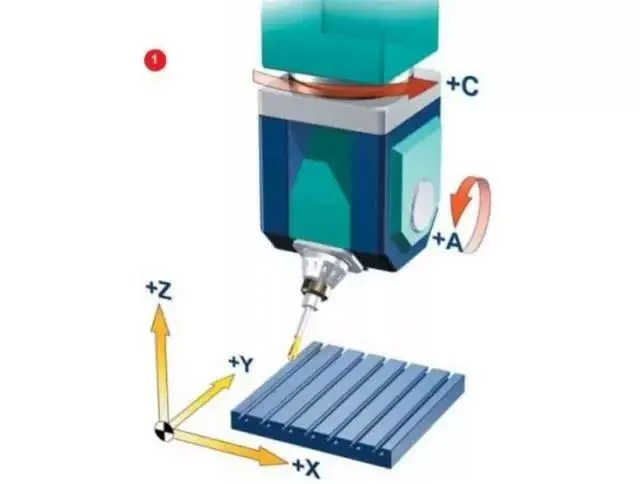
Two rotating coordinates directly control the direction of the tool axis (double swing head form)

The two coordinate axes are at the top of the tool,
But the rotation axis is not perpendicular to the linear axis (pitch type swing head type)

Two rotating coordinates directly control the rotation of the space (double turntable form)

The two coordinate axes are on the worktable,
But the rotation axis is not perpendicular to the linear axis (pitch type table)
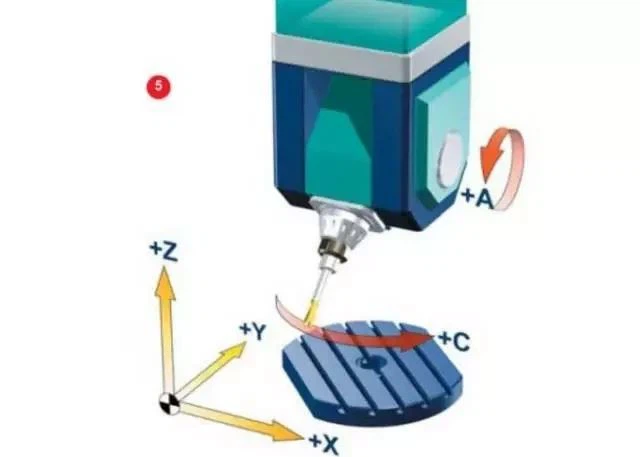
Two rotating coordinates act on the tool,
One acting on the workpiece (one swing and one turn)
*Terms: If the axis of rotation is not perpendicular to the linear axis, it is considered a "sag type" axis.
Having seen these 5 Axis machine tools, I believe we should understand what and how the 5 Axis machine is moving.